
AI visibility. Commerce intelligence. Clear next steps.
RunCommerce Discovery.
Understand how your business is found, understood and recommended by AI.
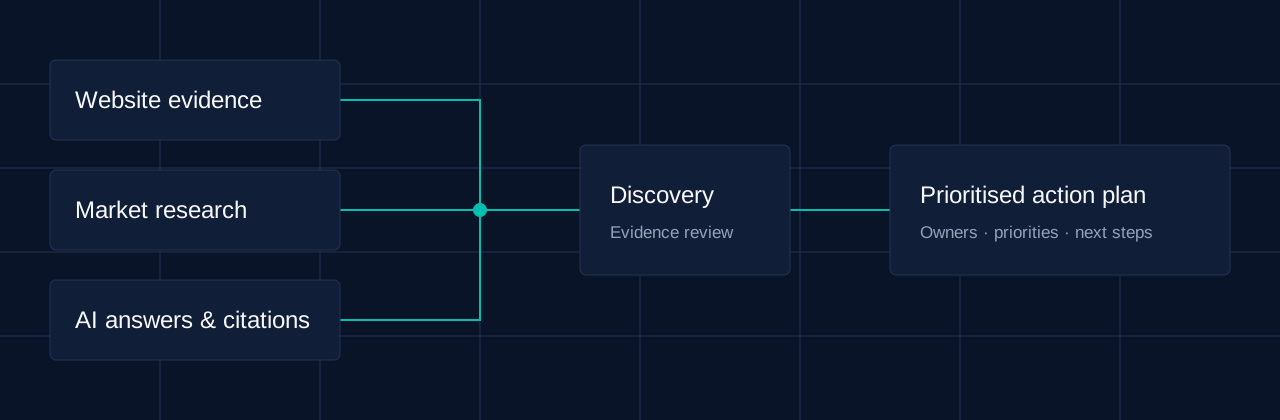
Not another list of SEO warnings. Discovery connects your website, product catalogue, market position and visibility in large language models to an evidence-led action plan.
13
review areas
42
deterministic audit rules
59
technology & commerce detectors
10
AI-access diagnostics
Coverage categories overlap and are not a combined check total. Reviews use sampled pages; selected scope, available evidence and plan determine coverage.
Built for the way people discover products now
Being indexed is not the same as being recommended.
What do AI answers actually say?
Discovery tests buyer questions with Gemini and Claude. It records the answers, whether your brand is mentioned without prompting, who is recommended instead and which sources are cited.
Can AI retrieve your products?
Robots permissions and live-fetch diagnostics help reveal access barriers for AI retrieval. ChatGPT Search, Perplexity and Claude access signals are examined separately from model-training permissions.
Can AI understand your catalogue?
Product discoverability, structured data, category and intent pages, naming consistency, currency URLs and feed readiness help explain whether your products are usable as machine-readable information.
AI-answer tests are a snapshot, not a permanent ranking. Crawler access does not prove recommendation inside an AI app. Discovery also researches brand context on Reddit, Quora, Wikipedia, Trustpilot, YouTube, Amazon, LinkedIn and editorial lists.
More than search engine optimisation
SEO is one part of the picture.
Traditional SEO remains essential. Discovery goes further: can customers buy easily, can you measure what happens, and can AI systems access, understand and cite the information that makes your business relevant?
| Focus | Typical SEO tool | RunCommerce Discovery |
|---|---|---|
| Search foundations | Crawlability, titles, headings and structured data | The same foundations, connected to commerce and AI readiness |
| AI understanding | Often focused on search-engine signals | Buyer-question testing, recommendations, citations and retrieval access |
| Commerce context | Usually centred on pages and search traffic | Store capabilities, tracking, product data, competitors and market context |
| Evidence | Search metrics and audit findings | Website observations, API measurements and clearly identified research |
| Next steps | An optimisation backlog | A prioritised action plan with ownership and review comparisons |
Individual SEO products vary; this comparison describes a typical search-first workflow.
Website. Market. Visibility.
The 13 areas of a Discovery review.
01 / Website
Site & tech stack
Which platform, CMS and frameworks the site is built on.
02 / Website
Analytics & tracking
GA4, Tag Manager, pixels and consent tooling — present or missing.
03 / Website
Site capability
Search, filtering, reviews, checkout, currencies, languages, content.
04 / Website
Technical health
Robots, sitemap, HTTPS and redirects, structured data and broken links across sampled pages.
05 / Website
AI search & crawler access
Per-agent robots.txt rules, Cloudflare/bot-management behaviour, and how readable the catalogue is to ChatGPT, Perplexity, Gemini and Copilot.
06 / Website
Page speed
Google PageSpeed Insights for desktop and mobile, with Core Web Vitals.
07 / Market
Marketplace presence
Where else the brand sells — Amazon, eBay, Etsy, Zalando and others.
08 / Market
Price comparison
How the main products are priced against other sellers online.
09 / Market
Competitor landscape
The core competitors and how they position themselves.
10 / Visibility
Social presence
Social channels linked from the business’s own website and potential channel gaps.
11 / Visibility
Paid advertising
Advertising network tags detected on the site, not verified campaign activity or spend.
12 / Visibility
SEO performance
Titles, meta descriptions, headings, content depth and structured data, measured across crawled product, category and content pages.
13 / Visibility
AI visibility (AEO)
AI-answer tests with Gemini and Claude, recommendations, cited sources and external brand context.
Coverage
Every registered rule, detector and research source.
Crawlability & indexation
Content & on-page search
Speed & performance
Structured product data
Links & site architecture
International search
Platform & technology detection
Analytics & measurement detection
Commerce capability detection
Advertising tag detection
AI crawler access & catalogue readiness
External sources for AI visibility research
Linked social profiles
From findings to action
Know what to fix. Know why it matters.
AI helps interpret evidence and frame recommendations. Deterministic rules establish technical findings. Your team reviews the conclusions and chooses the work, rather than relying on an unexplained score.
- Findings with severity, affected pages and recommended fixes
- Website observations and API measurements separated from research and estimates
- Market-aware competitor, marketplace and pricing context
- Action tasks with priorities, owners, dates, status and comments
- Rerun reviews and compare with earlier results
- PDF and PowerPoint reports for stakeholder discussion
Market research is not a live sales, advertising-spend or exact-product pricing feed. Findings are recommendations, not automatic changes to your store.
Discovery, answered.
RunCommerce Discovery