
A RunCommerce merchant guide
AI eCommerce
AI eCommerce is the use of artificial intelligence to support online retail, from preparing product listings to analysing performance. For merchants, the practical opportunity is reducing repetitive work while keeping people responsible for what customers see.
Talk to our team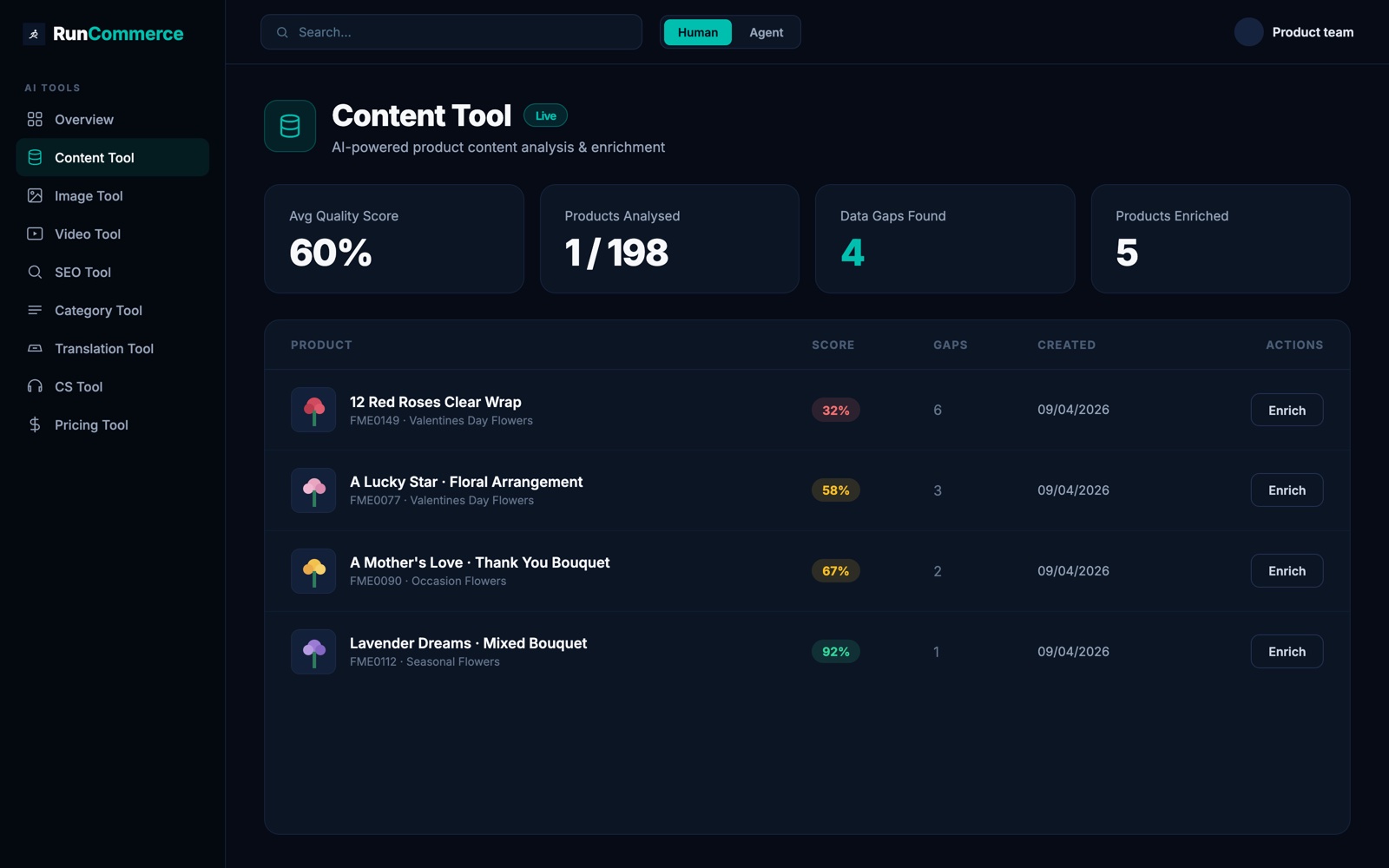
What does AI mean for eCommerce?
AI commerce is a broad category, not a single product. It can describe software that helps a retailer write product content, organise a catalogue or understand trading data. It can also describe customer-facing experiences that help shoppers discover products. Those uses have different requirements and should be evaluated separately.
For an eCommerce team, a useful starting point is a recurring task with a clear input and an output someone can check. A product description, for example, starts with product facts and ends with copy that a merchandiser can review. That is a more concrete brief than asking AI to improve the entire business.
Practical AI eCommerce use cases
Product content: turn existing product information into suggested titles and descriptions. Review specifications, sizing, materials and claims against the source before publishing. RunCommerce’s Content Tool grades and rewrites listings so the team can assess proposed improvements.
Product imagery and video: prepare additional creative from product photos or a description. Check that generated material represents the actual product accurately. Translation: adapt catalogue content for additional markets, with review of local terminology and source changes.
Catalogue structure and SEO: suggest categories, page titles and meta descriptions. Good organisation and accurate descriptions help people navigate a store; AI-generated keywords do not guarantee search rankings. Pricing and analytics: use competitor information and GA4 data to inform decisions, rather than treating a recommendation as an instruction to change prices.
How human-reviewed AI automation works
RunCommerce’s workflow is connect, run, review and publish. Tools use your connected catalogue, including products, categories and images. You scope a task to one product or a larger set, then inspect the proposed output before deciding whether to accept, edit or reject it.
This is merchant-side operational automation, not a promise that a store runs without oversight. Keeping approval in the workflow matters when a change affects product accuracy, brand voice or commercial decisions. Your team remains responsible for checking the result.
How to choose AI tools for your online store
Start with the work your team repeats most often. Record how long it takes today and how many corrections it needs. Choose a small, representative catalogue sample, including difficult products rather than only the easiest listings. Define the checks a reviewer must complete before anything goes live.
Ask how a tool connects to your existing store, what data it uses, how suggested changes are reviewed and whether change history is available. RunCommerce’s AI Automation Layer is designed to work with an existing commerce stack; its platform and managed services are separate options for teams with wider needs.
Compare time saved with review time, output accuracy and total cost. A faster draft is useful only if the final result remains trustworthy. Do not assume that using AI automatically increases sales or reduces costs by a fixed amount.
AI eCommerce versus agentic commerce
AI eCommerce covers many forms of assistance for retailers and shoppers. Agentic commerce usually refers more specifically to AI taking actions towards a shopping goal, such as finding, comparing or buying a product on a customer’s behalf. Merchant-side content automation and customer-side purchasing are related trends, but they are not the same capability.
RunCommerce focuses on AI tools for eCommerce operations, an AI-native commerce platform and a managed service team. Its tools use human review. Explore the agentic commerce guide for the shopper-side definition and the questions merchants should ask about permissions, product information and checkout.