
A RunCommerce merchant guide
Agentic commerce
Agentic commerce describes AI systems acting towards a shopping goal on a customer’s behalf, such as discovering, comparing or purchasing products. How much action the system can take depends on its design and the permission the customer gives it.
Talk to our team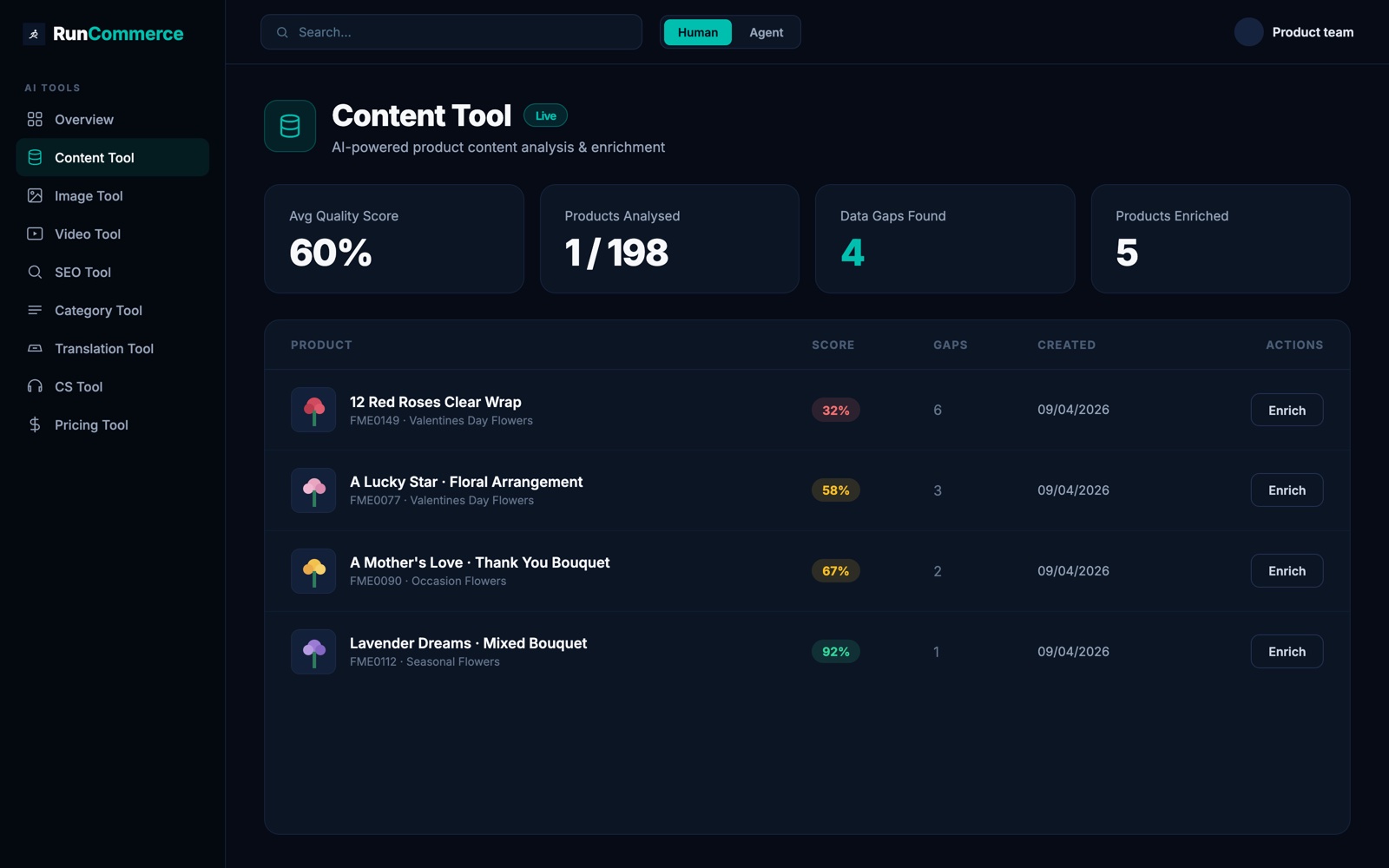
What is agentic commerce?
In a conventional online purchase, a person searches, compares products and completes checkout. In agentic commerce, AI can carry out parts of that journey for them. Stripe describes this as software shopping on a customer’s behalf; the UK Small Business Commissioner also frames it around AI finding, comparing and buying products.
The term does not mean every purchase happens without a person. Some experiences make recommendations and wait for approval. Others may be authorised to act within a defined budget or set of constraints. Merchants should ask exactly which actions a particular service supports rather than assuming a universal model.
How is it different from AI eCommerce automation?
The distinction is whose task the AI performs. Shopper-side agentic commerce helps a customer reach a purchasing goal. Merchant-side AI eCommerce automation helps a retailer complete operational work, such as drafting product descriptions, preparing images or reviewing pricing information.
RunCommerce’s published offering is merchant-side: task-scoped AI tools, an AI-native commerce platform and managed services. Its tools present suggestions for a person to review and approve. This should not be read as a claim that RunCommerce supplies autonomous shopper purchasing or integrates with every agentic checkout service.
Why product information matters
A shopping system cannot reliably compare products if their details are missing or inconsistent. The same foundations that help a person shop are useful here: accurate product names, variants, dimensions, materials, availability and delivery information. Keep pricing and stock information aligned with the store rather than relying on an old description.
Useful product pages answer real purchase questions. State what is included, who the product is for and what restrictions apply. Structured product data should describe the visible product accurately. It is not a shortcut to being recommended by an AI system, and no specific format guarantees inclusion.
RunCommerce’s catalogue, content, translation and SEO tools support the operational work of preparing product information. Better-maintained data is a practical foundation for commerce in general, not a guarantee of compatibility with a particular shopper-side service.
Questions merchants should ask about agentic checkout
Before adopting a shopper-side integration, ask how the customer gives permission, whether they must approve the final purchase and what happens if a recommendation is wrong. Establish how payment authorisation, order confirmation, returns and customer support are handled. These are evaluation questions, not capabilities shared by every service.
Confirm which regions, payment methods and commerce platforms the service actually supports. Ask the provider for current documentation and test the real purchasing journey, including out-of-stock products and failed payments. An emerging category name is not evidence that a specific integration is available.
What can retailers do now?
Begin with catalogue quality and a clear buying experience. Audit a sample of products for missing attributes, confusing variants and outdated information. Give a named person responsibility for approval of changes. Keep customer policies easy to find and consistent with what checkout promises.
For merchant-side automation, start with one repeatable task and measure the result before widening the scope. RunCommerce’s AI tools can support catalogue content, creative, translation, SEO, pricing and analytics workflows. Talk to the team about your existing store and review requirements rather than assuming you need to replace your entire stack.
Is ACommerce the same as agentic commerce?
The unspaced term aCommerce also refers to a separate eCommerce services company operating in Southeast Asia. RunCommerce is a different business. If you mean AI-enabled retail as a category, AI commerce or agentic commerce is clearer, with the latter usually referring to AI acting within the shopping journey.
Use the specific capability when comparing providers: merchant-side content automation, AI-assisted product discovery or authorised purchasing. That avoids confusing a brand name with a technology category.